By Mehak Faryal Mir
When people picture Kashmir, they often think first of its mountains, lakes and gardens. But Kashmir is more than a landscape. Its identity lives in the everyday—in the warmth of a cup of kahwa, the sound of traditional music, the intricate work of an artisan, the food served to a guest and the stories passed from one generation to another.
Kashmiri culture is shaped by a long and complex history and by the many communities, languages, traditions and artistic practices that have developed in the Valley. It can be experienced in grand celebrations, but just as often it appears in small, familiar rituals of everyday life.
Here are some of the traditions and cultural expressions that help tell the story of Kashmir.
1. Hospitality Is at the Heart of Kashmiri Life
One of the simplest ways to understand Kashmir is through its hospitality.
Visitors are often welcomed with food and drink, and kahwa—the fragrant Kashmiri tea traditionally prepared with saffron, spices and nuts—is closely associated with hospitality and social occasions.
A Kashmiri home is not simply a place to live. It can also be a place where stories are exchanged, guests are fed and memories are created around a shared meal.
That spirit of welcoming people into one’s home is one of the most enduring parts of the Kashmiri experience.
2. Kashmiri Food Is a Story of Its Own
Food is another essential part of Kashmiri culture.
Kashmiri cuisine has developed through different culinary traditions, including those of Kashmiri Muslims and Kashmiri Pandits. The result is a diverse food culture in which spices, yoghurt, aromatic ingredients and carefully developed cooking techniques play important roles.
For Kashmiri Muslims, Wazwan is perhaps the most recognisable expression of ceremonial cuisine. It is an elaborate multi-course feast prepared under the guidance of skilled cooks known as wazas. More than simply a meal, Wazwan has an important social and ceremonial role.
Popular Kashmiri dishes include Rogan Josh, Yakhni, Goshtaba, Dum Aloo, Modur Pulao and Methi Chaman. Kashmiri cuisine also includes an extensive range of breads, teas and everyday dishes that are less familiar outside the Valley.
Food therefore becomes more than something served at the table. It becomes a way of remembering family, occasions and place.
3. Kashmiri Craftsmanship Turns Everyday Objects into Art
Kashmir has a remarkable tradition of craftsmanship.
Among its best-known crafts are Pashmina shawls, Sozni embroidery, Kani weaving, papier-mâché, walnut wood carving, hand-knotted carpets and copperware. These crafts require specialised skills that have been developed and passed down through generations.
Pashmina is known for its fine, lightweight fibre, while Sozni is a delicate form of needle embroidery often seen on shawls and garments. Kani shawls are traditionally woven using small wooden bobbins, creating intricate patterns.
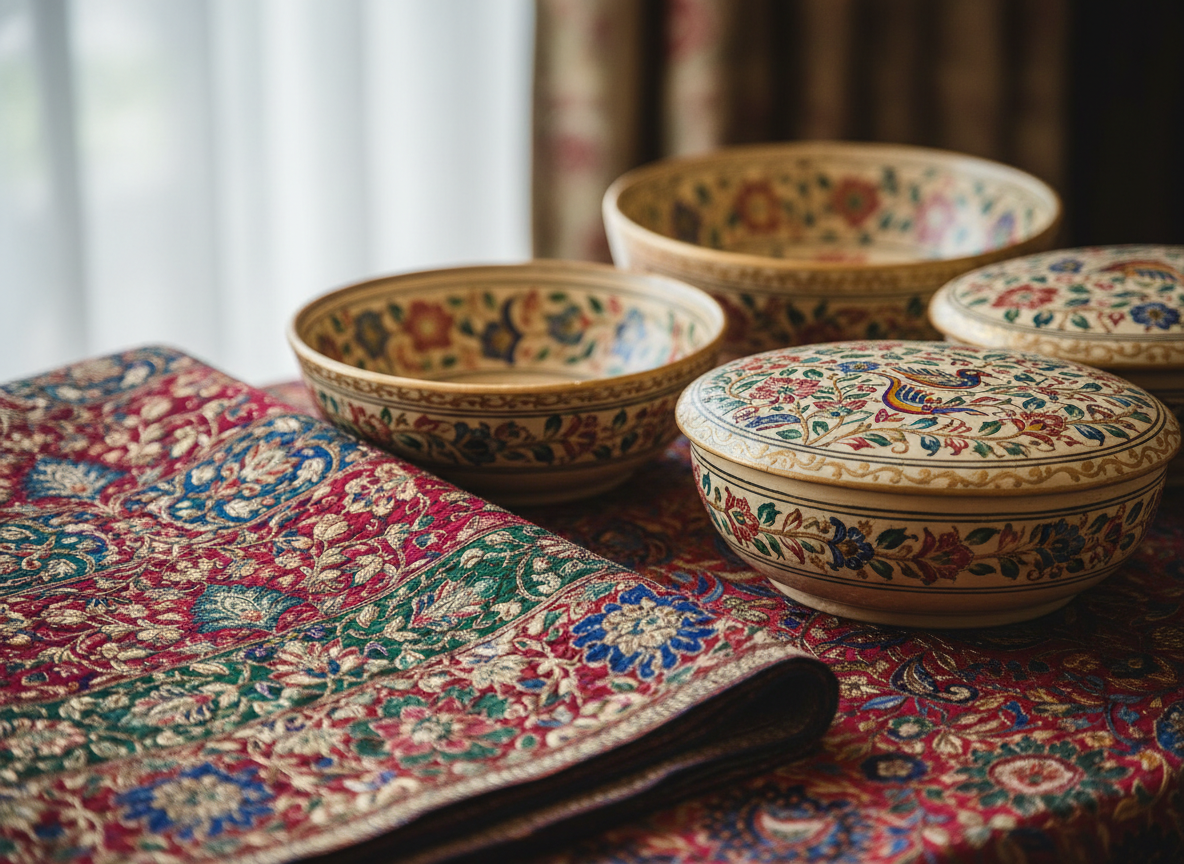
Then there is Kashmiri papier-mâché, where decorative objects are finished with detailed hand-painted designs, and walnut wood carving, which transforms locally sourced walnut timber into furniture and decorative pieces.
These aren’t simply souvenirs. They represent time, patience and the knowledge of artisans.
4. Music and Theatre Keep Old Stories Alive
Kashmiri culture is also expressed through music and performance.
Chakri is a popular form of Kashmiri folk music, traditionally associated with instruments including the rabab, sarangi and later the harmonium. Sufiana music, which developed in Kashmir with Persian influences, became an important classical musical tradition of the Valley.
Another distinctive tradition is Bhand Pather, a form of folk theatre combining drama, dance and satire. Performers use stories and humour to comment on social life and customs.
These traditions demonstrate something important about Kashmiri heritage: culture is not preserved only in objects and monuments. It also survives through sound, performance and storytelling.
5. Language Carries Memory
Language is one of the most intimate parts of cultural identity.
Kashmiri, locally known as Koshur, has its own rich literary and oral traditions. Like many languages with a long history, it carries expressions, sayings and ways of describing the world that cannot always be translated perfectly.
A language survives not only through books. It survives when grandparents speak to grandchildren, when families tell stories, when songs are remembered and when familiar phrases continue to be used at home.
That is why preserving language is also a way of preserving memory.
6. Festivals and Celebrations Bring Communities Together
Celebrations in Kashmir reflect the Valley’s diverse cultural and religious history.
Eid, Shivratri—known locally among Kashmiri Pandits as Herath—and other religious and seasonal occasions have their own customs, foods and family traditions.
Kashmir’s cultural heritage has developed through the interaction of different communities and traditions over centuries. The District Srinagar administration describes the region’s heritage as a diverse blend of languages, religions, art forms, rituals, music and historical influences.
This diversity is an important part of understanding Kashmir beyond the postcard image.
7. The Chinar, the Kangri and the Everyday Kashmir
Some symbols of Kashmir are immediately recognisable.
The chinar tree, with its large leaves and brilliant autumn colours, has become one of the enduring visual symbols of the Valley.
The kangri, a traditional portable fire pot carried beneath the pheran, is associated particularly with Kashmiri winters.
And the pheran, the loose traditional garment worn in Kashmir, remains an important part of the region’s cultural vocabulary.
Objects such as these matter because they connect culture with everyday life. They aren’t displayed behind glass—they belong to homes, streets, markets and memories.
8. Why Kashmiri Culture Is Worth Preserving
Culture can disappear quietly.
A craft can decline when fewer young people learn it. A language can weaken when it stops being spoken at home. A recipe can be forgotten when nobody writes down how it was prepared. A song can disappear when the people who know it are no longer around to teach it.
Preserving Kashmiri culture therefore isn’t only about protecting monuments or displaying traditional objects. It is about keeping living knowledge alive.

That means supporting artisans, documenting stories, learning traditional music, cooking family recipes, speaking local languages and creating spaces where younger generations can encounter their heritage.
Kashmir Is More Than a Place
Perhaps the most beautiful way to understand Kashmir is to look beyond its scenery.
It is in the artisan patiently working on a piece of embroidery.
It is in the aroma of spices rising from a family kitchen.
It is in a grandmother telling a story that has been told many times before.
It is in music carried across generations.
It is in the ritual of serving tea to a guest.
And it is in the objects, recipes, photographs and letters that allow one generation to leave something behind for the next.
Kashmir is not only somewhere you visit. It is a culture you can listen to, taste, hold and remember.
At Kostur Club, we believe that the most meaningful way to experience a place is through the stories and details that make it home. Through letters, objects, recipes and cultural fragments from Kashmir, we hope to bring a little of that experience closer—one story at a time.
Explore the stories of Kashmir with Kostur Club.


Leave a Reply